By Tara Sims, Archivist and Special Collections Librarian.
Nothing about a sixteenth-century anthology about gout suggests it should be wearing a page of medieval church music; yet, here we are, discussing a 1592 compilation on podagra, dressed in its Sunday best.
This book is wrapped in a single sheet of parchment donning red staff lines, heavy square black music notes, and lines of Latin written in a tight gothic hand. Centuries of handling have worn the skin smooth and slightly translucent, so faint echoes of more music bleed through from the other side.

[On the Prevention and Treatment of Arthritis: Consultations of the Illustrious and Most Learned Physicians of Our Age Front Cover, McGovern Historical Center]
In the process of looking for answers to explain the union of this unlikely duo, the focus of this blog took a major turn from originally being a history lesson on the practice of binding books in “liturgical waste” (compliments of the Protestant Reformation beginning in the 16th century) to a small but meaningful case study in bibliographic truth; namely, the kind of truth that comes from a book’s presentation of physical evidence by way of careful examination of its anatomy, rather than assuming a narrative based on its cover or what’s printed inside. For example, a title page records one moment in a book’s life: its birth. But who owned it afterward? Was it altered? If so, why, and how? What has been removed? Added? At what point did this book lose its status as a “perfect” copy?
None of this information is recorded, unless and until either a special collections librarian, bibliophile, and/or rare book expert or collector has painstakingly examined and documented, page-by-page, any flaws, contradictions, or irregularities (if any) that exist in a vast majority of books published during the hand-press era (ca. 1455-1800). It follows that the older a book is, the harder it can be to find a complete copy. While clues to a book’s past are oft well-hidden and can escape detection entirely (or simply no longer exists), they are not all hopelessly obscure and are quite obvious to both the rare book novice and expert alike.
Uncovering the truth about the state of a rare book requires one to look at and contextualize its physical traits and characteristics through the lens of countless scenarios that it may have been subjected to since the moment it left the publisher’s shop. It goes without saying that understanding how books were constructed and how these methods remained unchanged for centuries until the early 19th century is helpful in detecting any irregularities or flaws that either validate or reject the adopted notions of its completeness.
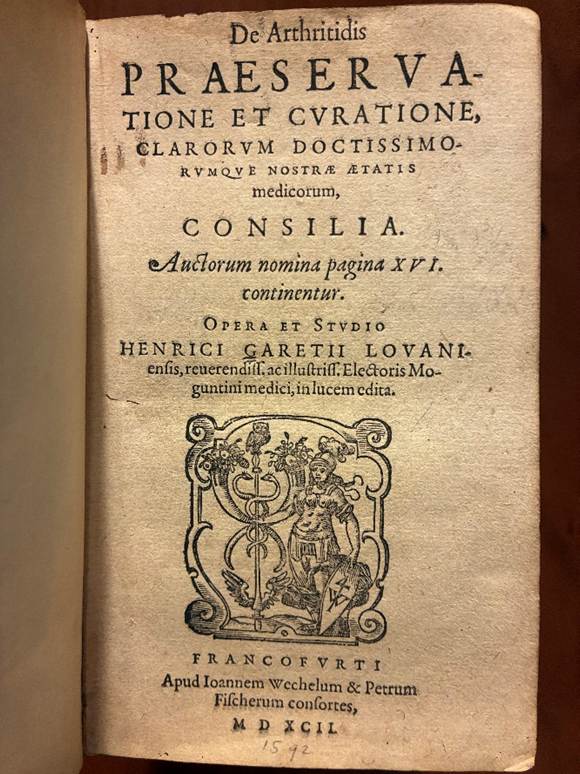
What the title page says
De arthritidis praeservatione et curatione, clarorum doctissimorumque nostrae aetatis medicorum, consilia” – or, “On the Prevention and Treatment of Arthritis: Consultations of the Illustrious and Most Learned Physicians of Our Age”; Frankfurt, printed by Johann Wechel and Peter Fischer, 1592. The compiler was Henricus Garetius of Louvain, physician to the Elector of Mainz.
Garetius gathered other physicians’ case letters, or consilia, and published them together, turning a genre that had circulated privately into something any reader in Europe could buy. The result is the texture of early modern medicine that gets lost when we read only the famous treatises: regimens for diet and sleep, recipes for plasters and unguents, and long disagreements about whether the offending humor descends from the brain or rises along the spine.
What the parchment says
The text and notation are perfectly legible if you read Latin and chant. I do neither, so I photographed the book with its cover opened flat, text block face down, so that Latin and the music ran uninterrupted across both boards and the spine, and went hunting for a match.

The Cantus Index database, which catalogs the chants of the Divine Office and links them to digitized manuscripts, turned one up quickly and then kept turning them up. The same passage, with the same notation, appears in an antiphoner at Utrecht University Library and in manuscripts from Hungary, Germany, France, and the Low Countries, most of them dating from the fifteenth and sixteenth centuries, as well as a few dating far earlier.

The text is the end of Psalm 94, the Invitatory, that opened the daily cycle of the Divine Office at the very start of the morning hours and was sung in monasteries and cathedrals every day of the year. That ubiquity also explains why the text alone cannot tell us where our leaf was made: every choir in Latin Christendom sang it.
The notation tells the rest. Four-line staves with square notes are the format used for roughly a thousand years to write Gregorian chant for singers, and text and music laid out this way come from one kind of source: a noted choir book. Since the psalm belongs to the Office rather than the Mass, that source was almost certainly an antiphoner—one of the great books made for a community, whether cathedral chapter, monastery, or friary, to sing the hours in Latin.
Which century does this fragment originate from? This is hard to say with certainty. The leaf may or may not be older than the book it now covers. Large-format antiphoners were produced by hand well into the sixteenth, seventeenth, and in some places the eighteenth century, long after print had taken over everything else.
Why a choir book?
Our book is an octavo. It is small; it sits comfortably in one hand. That sounds like a detail only a cataloger would care about, until it explains something about the cover.
The choir book this leaf came from was the opposite of small. Choir books had to be enormous, because a group of singers around a lectern all needed to read the same page from several feet away: big letters, widely spaced staves, very large sheets of parchment. A single leaf could stand two feet tall.
That size is exactly what made it useful to a binder. One leaf from a choir book is big enough to wrap a small book completely—front board, spine, and back—in one continuous piece with nothing left over. Our octavo is covered by exactly one leaf. Few other kinds of manuscript produced sheets that large, which is why bindings of this sort are so often liturgical. The bulk that made a choir book awkward to use is precisely what made it valuable as raw material.
How a manuscript becomes a cover
The short answer: parchment was expensive, and obsolete manuscripts were not.
Once printing spread across Europe after about 1450, paper took over as the surface for text, largely because it accepts printing ink far better than animal skin. But the qualities that made parchment a poor printing surface made it a superb structural one: it cuts cleanly, folds without cracking, and holds up under strain, so binders kept using it long after printers had given it up. Meanwhile, an enormous quantity of parchment was losing its value as text. Manuscript copies of works now in print were redundant, and liturgical manuscripts for local uses fell out of favor as service books were standardized and reprinted. A great choir book, once the most expensive object a parish owned, could end up as a stack of very good parchment.
In essence, the handwritten book went obsolete when print arrived; the parchment it was written on did not.
The scale is easy to underestimate. Scholars believe that roughly one in five European bindings made between 1450 and 1600 contain medieval manuscript fragments somewhere, as covers, spine linings, pastedowns, or the narrow guards that protect the fold of each gathering.[1] .
But what about Henry VIII?
Out the gate, I had assumed this liturgical music leaf-turned book binding was another casualty of the English Reformation—a reasonable assumption, to be sure. I have read about books bound in liturgical waste before, but I had never actually seen one in person, so the discovery of this book was quite exciting for someone who so badly wanted it to be connected to such an infamous historical event.
For more context, Henry the VIII ordered the dissolution of the monasteries between 1536 and 1541, and the campaigns against “superstitious” service books that followed emptied monastic libraries and stripped parish churches, and the parchment went to binders, grocers, and soap boilers. N. R. Ker’s foundational survey of Oxford bindings found liturgical books pouring into English bindings after 1540.[2] The association is well earned.
The immediate trouble with English Reformation theory was that Ker was describing English bindings, and this, of course, is not an English book. It was printed in Frankfurt and compiled by a Catholic physician from Louvain in the service of a Catholic prince-elector. Specialists working on music fragments today confirm Ker’s pattern and then qualify it: liturgical waste turns up in bindings well before and long after the 1540s, the trends differ from one country to the next, and obsolescence had plenty of causes besides reformation.
This leaf-turned-book binding was not an example of liturgical waste, or a victim of circumstance related to Henry VIII’s marital or papal quarrels. The likelier story is much more anticlimactic in the storytelling sense, but it does have a much larger artifactual reach in the end…which I would argue is the best outcome of the two.
Where the book stopped agreeing with itself
By this point, I had what I thought was a tidy thesis: a binder somewhere wrapped this medical book in an old choir book leaf around 1592 for no other apparent reason other than parchment is parchment, and useful is…useful. Something was still not quite right, though. I felt like there was a crucial piece of evidence I was missing which would drastically change my reporting on this unique tome.
As such, the book came out of the vault for a second look. Now that we were looking for specific anomalies that give away the real—or more accurate dates—of when a book was bound, we could clearly see that the parchment sat much too neatly on the bookplates themselves. They were perfectly square, centered, right side up, with the psalm running across the spine so you can follow it from front cover to back. Period waste bindings are careless about this, because to a working binder the sheet was material, not image. Sixteenth-century examples in other collections turn up sideways, upside down, or cut straight through a word.
My colleague handled that second examination and photographed the spine and boards. The endpapers, she said, felt wrong: too smooth, too new. She was right, and the spine settled it. The text block is sewn onto modern machine-woven tapes, and at head and tail are stuck-on woven headbands, flat manufactured strips glued to the spine rather than endbands sewn through the gatherings—neither of which existed before the nineteenth century.
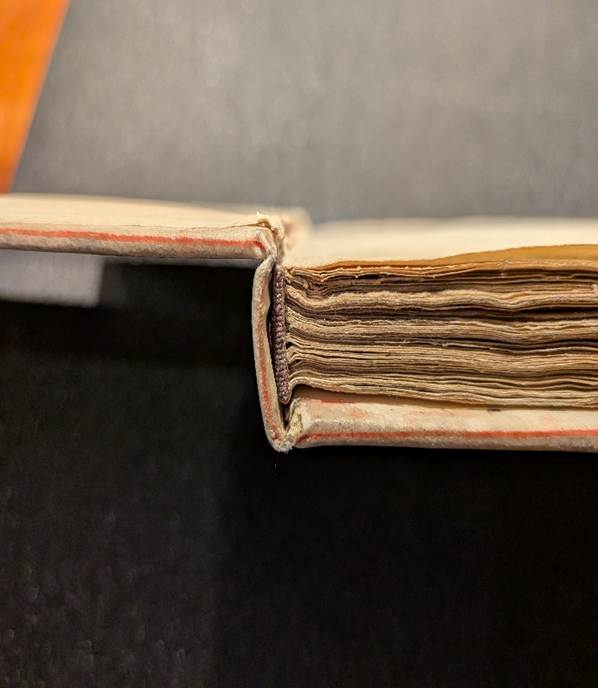

The endpapers are smooth, evenly formed sheets, nothing like the handmade laid paper of the text block, and since endpapers are added at binding rather than printing, they date the binding, not the book. And the spine of the text block is frayed and scarred the way paper gets when an earlier binding has been stripped away. This book has been bound at least twice, and we are now most likely looking at the second.

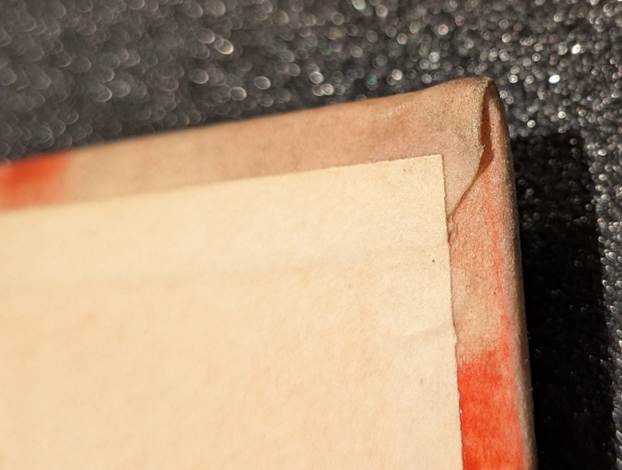
The outside of the parchment argues for the sixteenth century, the inside for the twentieth, and the inside wins. A binder can reuse a leaf of any age, so the cover sets no limit on when a binding was made. Tapes, headbands, and endpapers are added at the moment of binding, and they cannot be older than the moment they were manufactured.
Another interesting detail that jumped out during this second trip to the vault is that we may even have an idea is even a solid lead on who may be responsible for this perfect binder’s job. Penciled inside the board is what appears to be a German bookseller’s note: a short collation and a price in Goldmark, a designation used to signal real value during and after Germany’s inflation years. If my deciphering and research of these handwritten notes holds up, the book passed through the German antiquarian trade in the 1920s, which happens to be exactly when Reginald Burbank was buying.

Frankfurt to Houston
Inside the front cover is a bookplate: a bare foot, swollen at the great toe, with a small demon sinking its teeth into it—the visual shorthand for gout that runs from Gillray’s caricatures through a century of medical illustration. Beneath it: Ex Libris Reginald Burbank.

Burbank was a twentieth-century American physician who assembled a large collection of historical books and manuscripts on gout, rheumatism, and arthritis, which he read, and had translated, for his own research. The collection came here: the printed volumes form the Burbank-Fraser Collection on Arthritis, Rheumatism and Gout, and the Reginald Burbank, MD Papers are held in the archives at the McGovern Historical Collection.
So the sequence of this book’s relocation, as best we can reconstruct it, looked like this: a choir book used in a monastic setting was broken up somewhere in Europe, at a date and for reasons we cannot reasonably name, and one leaf from it circulated in the trade for who knows how long. Three centuries after our book was printed, somebody—probably a German dealer, and probably in the 1920s—put parchment leaf and book together, carefully enough that the psalm reads across the covers. Then Burbank bought it, added it to his collection on gout, and eventually it all got to Houston through the donation of this collection to the Texas Medical Center Library.
The parchment was recycled twice: once for its strength, and once—much later—for its beauty.
Why this description matters and belongs in the catalog
Cataloging an object like this means describing two things that were never meant to be one. The 1592 imprint has an author, a compiler, a printer, a place, and a date. The cover has none of those—only a script, a notation system, a liturgical use, but cannot even be roughly dated to a particular century. On one hand, the cataloger employs certain standards and rules of bibliographic librarianship; on the other hand, the cataloger was assuming the work within the confines of a field known as “fragmentology”, which is the study of surviving fragments of manuscripts (mainly manuscripts from the Middle Ages and the Renaissance). Scholars around the world use databases like Cantus Index and Fragmentarium to identify stray leaves like this one. The hope is that one day, a reassembly of the countless dismembered books will be reunited with their lost counterparts.
Although all of what presumably remains of the medieval manuscript is this singular leaf of parchment, at least now we have the honor of ensuring its ongoing survival and preservation, not to mention the privilege, to be given the responsibility of describing it to the world with accuracy and pride.
References
This Item
Garetius, Henricus, ed. De arthritidis praeservatione et curatione, clarorum doctissimorumque nostrae aetatis medicorum, consilia. Frankfurt: Johann Wechel & Peter Fischer, 1592. Burbank-Fraser Collection on Arthritis, Rheumatism and Gout [RB 001], [call number]. Later binding (probably early twentieth-century) in a leaf from a medieval noted antiphoner.
Further reading
Utrecht, Universiteitsbibliotheek, Hs. 406 (Antiphonale), digitized at objects.library.uu.nl/reader/1874-327915 · N. R. Ker, Pastedowns in Oxford Bindings (1954) · Alexandra Barratt, “Waste not, Want not,” Parergon 32:2 (2015) · Anne Reynolds, “‘Such Dispersive Scatteredness,'” Journal of the Northern Renaissance (2017) · “Hidden in Plain Sight,” Underwood Law Library, SMU · “Early Modern Pragmatism,” WashU Libraries (2024) · Fragmentarium, DIAMM, and Cantus Index.
[1] https://www.fragmentology.ms/article/view/bodleian-in-situ-fragments/2718
[2] https://archive.org/details/fragmentsofmedie0000kern/page/n5/mode/2up