By Kelsey Koym, Archivist and Special Collections Librarian at McGovern Historical Center
Introduction
Every year the McGovern Historical Center staff spends a week in the Rare Book Room during the Christmas season, taking care of administrative and preservation tasks. McGovern houses a valuable series of collections, and these tasks are prioritized to ensure the longevity of these historical artifacts. We affectionally refer to this week as “Holly Jolly Week.”

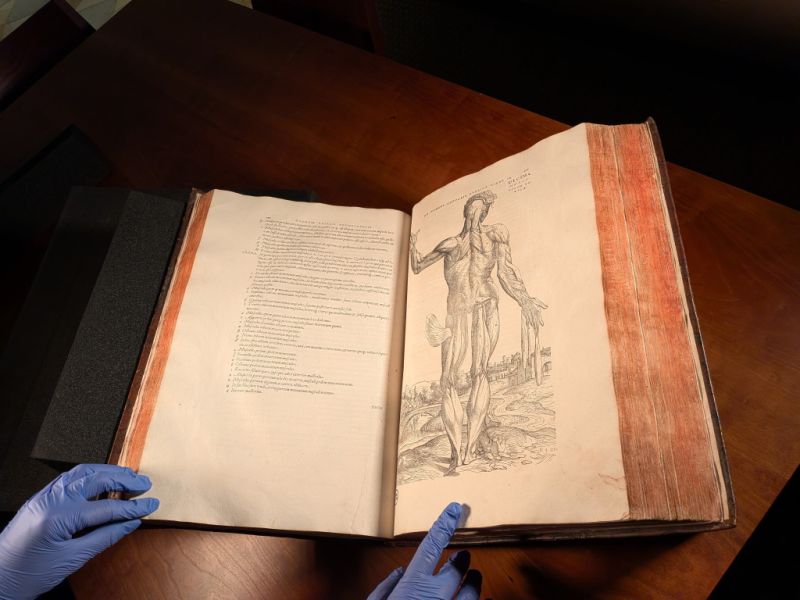
This year the team decided to capture some of the rare books in photographs. As the stewards of these collections, the photographs, or the book “glamor shots” as we began to call them, were an opportunity for us to share with the public some of the remarkable history that is being preserved by McGovern.

The subject of this blog post and the photographs shared here are from one of McGovern’s most prized possessions: De Humani Corporis Fabrica Libri Septem (De Humani), or “On the Fabric of the Human Body in Seven Books” by Andreas Vesalius. To say this work revolutionized anatomy would not be charitable to the impact this volume has had on the history of human medicine. This is the first post out of three that will detail information about McGovern’s first edition copy of Andreas Vesalius anatomical volume.
Bibliographic Background
McGovern’s copy is an original, first edition, supervised by Vesalius himself, published in 1543. The work was the product of the press of Johannes Oporinus in Basel, and Vesalius oversaw the printings of these copies himself (Margócsy et al., 2018). The work served a two-fold purpose: dissection manual and anatomical atlas.
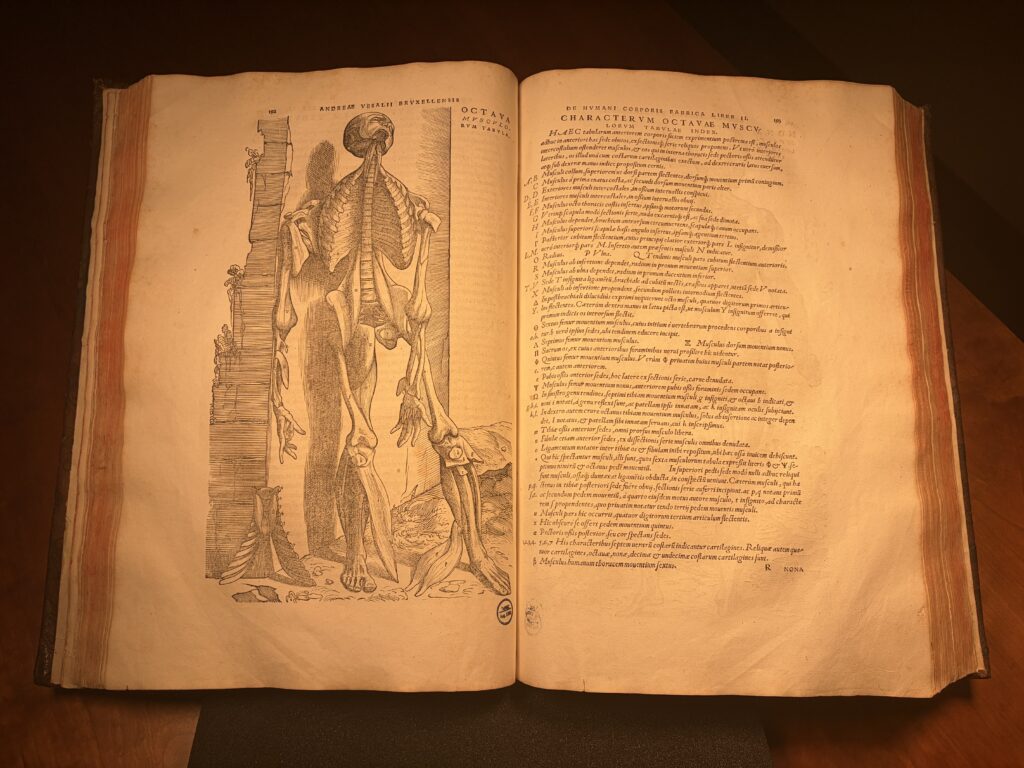
McGovern’s 1543 copy of De Humani is incredibly well preserved for a book that is nearly 500 years old. Although the book does not have its original binding, it is believed that the current binding is 17th century calfskin according to a letter that came with it (Schuman, circa 1953). The 1543 edition of De Humani typically includes approximately 660 pages (depending on the copy) with over 200 woodcut illustrations (Joffe & Buchanan, 2015). McGovern’s copy is 692 pages (346 leaves) according to Tara Sims, Archivist and Special Collections Librarian, who performed the first collation and foliation of the text this year. The first editions of the 1543 De Humani are sold for nearly $400,000 today (Margócsy et al., 2018, p. 1).
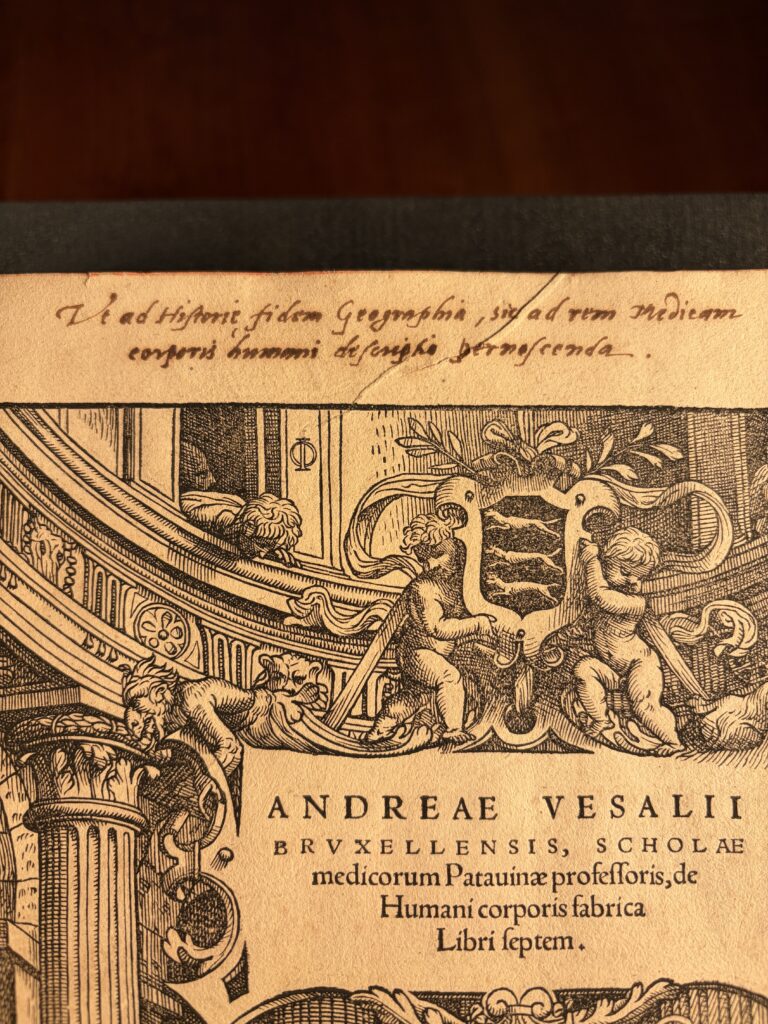
Different copies of the 1543 edition of De Humani have unique annotations or features. This is due to each copies’ provenance. For example, McGovern’s copy has an inscription on the frontispiece that states, “Ut ad Historie fidem Geographia, sic ad rem Medicam corporis humani descriptio pernoscenda.” When translated this means, “As geography is essential for historical truth, so the description of the human body is essential for medical knowledge.”
For the most thorough writing on the first editions of De Humani and where they are around the world, please check out The Fabrica of Andreas Vesalius : A Worldwide Descriptive Census, Ownership, and Annotations of the 1543 and 1555 Editions by Margócsy et al. (2018). According to this Census there are approximately 300 copies of the 1543 edition currently in existence (Margócsy et al., 2018, p. 3). The Census not only provides information about where the publicly available copies of the 1543 and 1555 editions are located; it provides information about what these copies have meant to its readers by analyzing copies’ unique annotations and provenance. What Margócsy et al. (2018) emphasize in their worldwide Census is that this book is not just about anatomy but about power (p.1).
Historical Context of Vesalius Work – the Early Modern Period
Vesalius’ anatomical textbook both challenged the past thousands of years of scientific history and was a landmark for how surgery would be studied for the next several centuries. Before Vesalius, the primary theories regarding anatomy were dominated by the works and translations of Galen of Pergamon. These theories were pervasive even up until a century after Vesalius would publish De Humani (Nutton, 2026).
Vesalius in many ways challenged the Galenic theories of anatomy. Although Vesalius would not totally abandon the “humoral theory” of medicine, his dissections and research would start to chip away at the stronghold both the Galenic and humoral theories had in the scientific world.

At the time of Vesalius’ education and work, the scientific and artistic worlds were changing. The year Vesalius was born was the beginning of the early Renaissance. Power was shifting. It was a time of major metamorphosis of societal organization and scientific knowledge. A deeper dive into this shift will be given during the third part of this series, where a biographical sketch of Andreas will dig into this period of history.
For this first part in the series it is important to understand that what made Vesalius’ work so different from the past thousands of years, is that he would perform dissections himself on human cadavers. This was considered for centuries to be highly taboo. Human dissections went against both religious and cultural norms. The Catholic church at the time considered the use of a knife on a corpse to be a desecration (Keeton, 1936, p. 103). In the early fourteenth century there were those who would open the door to Vesalius for his human dissections. These men included Mondino, Leonardo da Vinci, Berengarius de Carpi, and Sylvius, Vesalius’ medical professor at Paris (Keeton, 1936, p. 101).

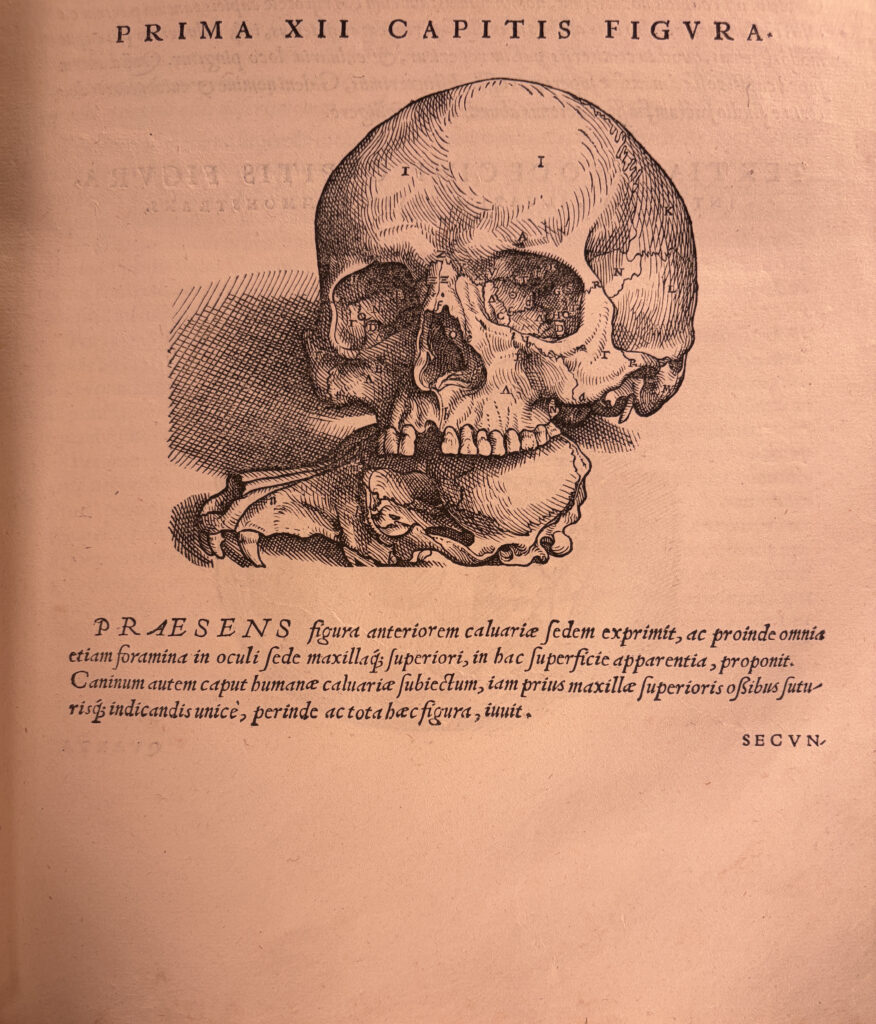
Galen had formulated his theories based on animal dissections, which left a lot to be discovered and remedied during Vesalius work, and Andreas Vesalius would mention Galen and Hippocrates many times throughout De Humani. Throughout Vesalius text you will see depictions of the bones and the dissections of monkeys, pigs, and dogs. These dissections are intermixed with the human dissections to demonstrate visually and in the Latin text, the differences found among Vesalius’, Galen’s, and Hippocrates’ theories of the body.
Vesalius not only was writing a work on what the human body contained, but De Humani was secondarily an instruction manual for how to carry out dissection. There are even historiated initials in the chapters of De Humani with Putti (cherubs), who demonstrate how to prepare human bodies for dissection. Information in Vesalius work also includes what tools were to be used for dissection.

What Vesalius did in De Humani can be summed up by Toledo-Pereyra (2008), “Andreas Vesalius took anatomy in all its complexity and transformed it into an incredible and interesting new medical discipline by systematically arranging and illustrating bones, muscles, veins, arteries, organs, and their intricate interrelationships (p. 232).” Vesalius would have a figure illustrated with several “layers” pulled from the body, and create a discreet numbering system, where there would be an accompanying key on the page next to the figure.

In the next blog post, I will discuss the provenance of McGovern’s copy of Andreas Vesalius’ anatomical atlas and textbook and what this investigation involved. In the final and third part of this series, I will discuss the life of Andreas Vesalius, the world he grew up in, and probe further into the artistic interpretations of the illustrations.
References
Joffe, S. N. & Buchanan ,V. (2015). Updated Census in USA of First Edition of Andreas Vesalius’ ‘De Humani Corporis Fabrica’ of 1543. International Archives of Medicine 8(23). 1-17. doi: 10.3823/1622
Keeton, M. (1936). Andreas Vesalius: His Times, His Life, His Work. Bios, 7(2), 97–109. http://www.jstor.org/stable/4604123
Margócsy, D., Somos, M., & Joffe, S. N. (2018). The fabrica of andreas vesalius : A worldwide descriptive census, ownership, and annotations of the 1543 and 1555 editions. BRILL.
Nutton, V. (2026, January 6). Galen. Encyclopedia Britannica. https://www.britannica.com/biography/Galen
Schuman, I. (circa 1953). Immortale Opus. [Letter from Ida Schuman to Dr. Hampton C. Robinson][Letter]. McGovern Historical Center, Texas Medical Center Library.
Toledo-Pereyra L. H. (2008). De Humani Corporis Fabrica surgical revolution. Journal of investigative surgery : the official journal of the Academy of Surgical Research, 21(5), 232–236. https://doi.org/10.1080/08941930802330830