By Tara Sims, Archivist and Special Collections Librarian
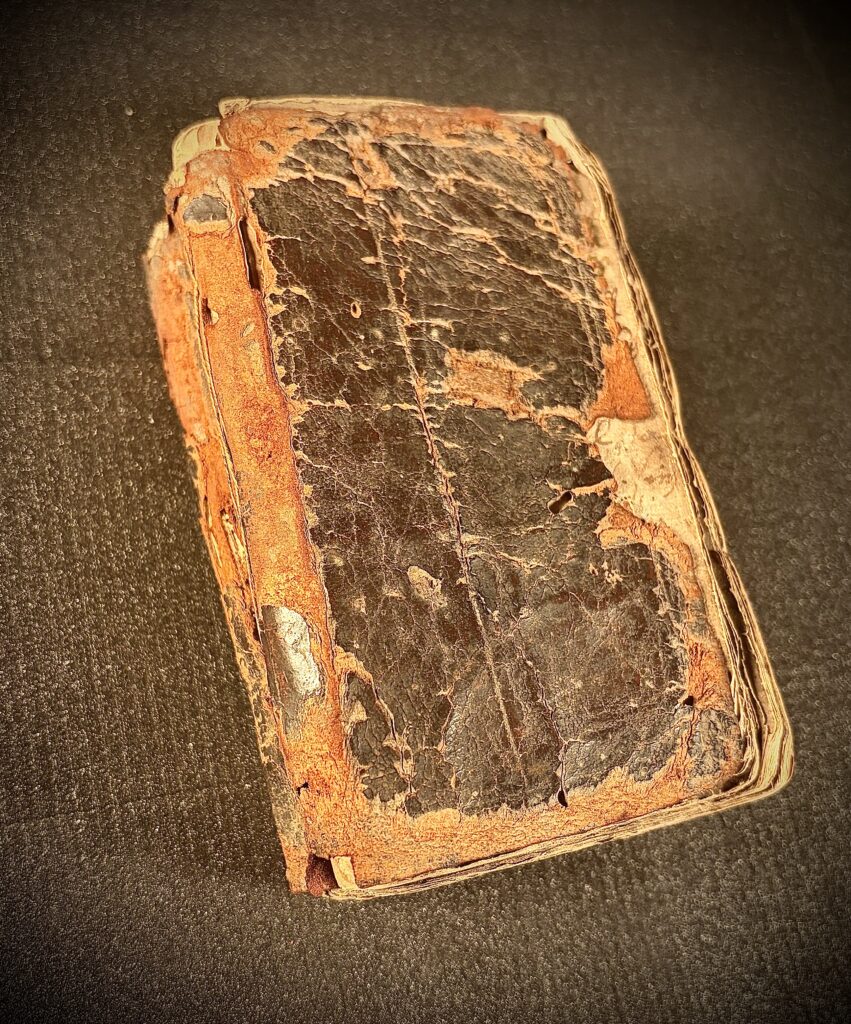
At first glance, this manuscript appears to be a quiet, little book—small, battered, and difficult to read. Located in the Texas Medical Center’s Rare Book Room vault, where the library’s most valuable and rare books are stored, this manuscript had little to no documentation regarding either the text’s origins or its nature and purpose—the only real clues to this mysterious object were hidden inside the cracked leather covers on pages darkened by age and shrouded in a dense cursive script that resists easy reading (to put it mildly), thus posing immediate challenges to the vast majority of 21st-century readers.
Though its contents have been elusive and largely unknown until now, it was originally believed to be a medieval, 15th-century manuscript, most likely predating the printing press (sometime before 1440). However, curiosity led me to look closely at this text as an historical artifact with stories waiting to be told as to its origins and past life. Sure enough, the evidence I gathered inside the centuries-old text was clear: we were not dealing with a 15th-century relic; rather, the dated inscriptions written in its preliminaries suggests this was a manuscript compiled and used across the 16th and 17th centuries. Indeed, one of the most remarkable qualities of this book is its sense of temporal layering. This is not a single-moment artifact; it is a manuscript that lived a fully dynamic existence—being revised, referenced, and relied upon for over 100 years.
With help from AI translation tools, we have been able to piece together what this book is, who owned it, and when it was made. What emerged is a story (incomplete as it may be) of an evolving body of materia medica, rooted in the ancient practice of alchemy, that stretches across 16th-and-17th-century Nuremberg and Bavaria. The manuscript’s owners cannot be accused of secret-keeping, as they collectively left behind an extraordinarily detailed pharmacopeia of complex formulations, preparations, and distillations designed to treat and/or prevent a myriad of diseases and illnesses.
(RB 005 McGovern Collection on the History of Medicine. Medical Manuscript, ca. 1526-1635.)
Small Book, Big Purpose
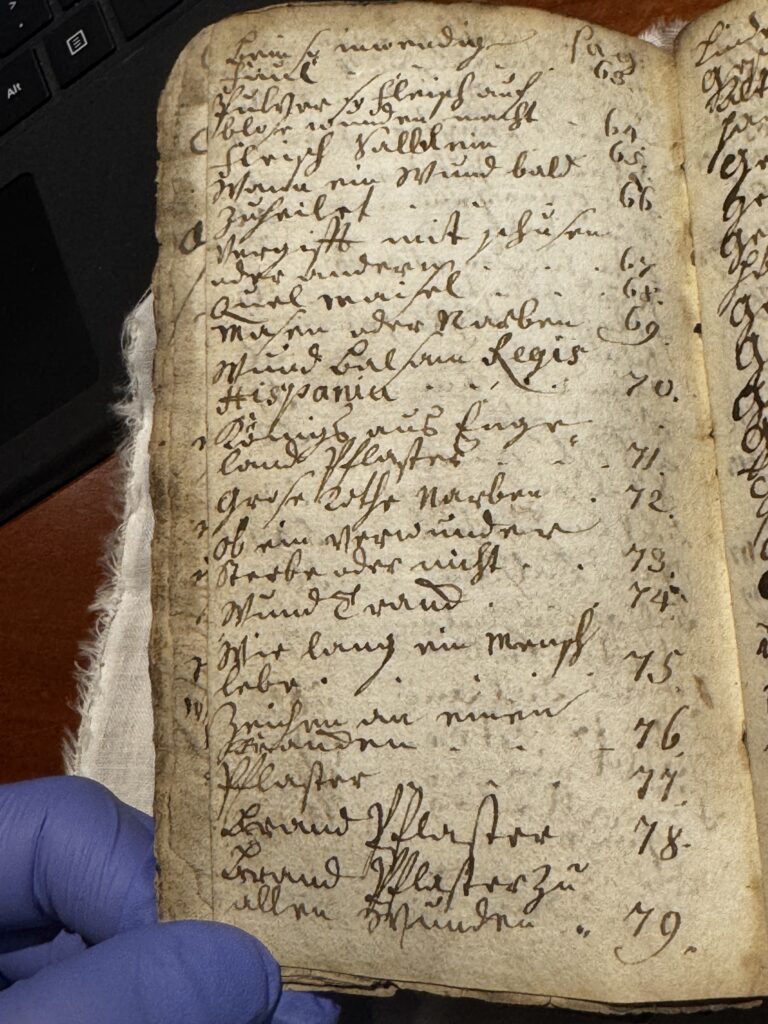
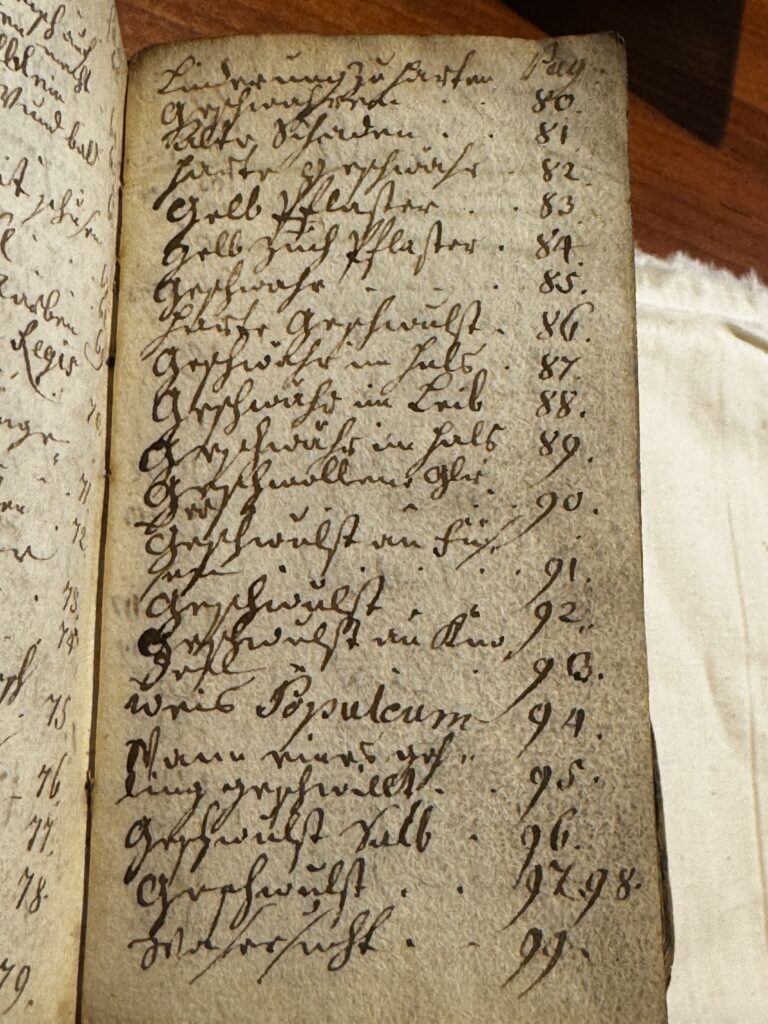
The book belongs to a genre called a Rezeptbuchlein—a hybrid of a personal pharmacopoeia, remedy notebook, and household medical manual used by medical practitioners in early modern Europe. Unlike formal printed medical texts, recipe manuscripts like this one often developed organically: copied from other sources, supplemented by experience, and expanded over time. These were working references carried by barber-surgeons, apothecaries, and physicians, blending herbal medicine, pharmaceutical compounding, and alchemy into a single practical toolkit. This one contains recipes for wound treatments, plasters, healing balms and oils, gout remedies, treatments for swelling and inflammation, compounded pills—as well as a section on plague prevention. It is organized with a numbered index, suggesting a compiler who expected to consult it regularly.
The manuscript includes index-like pages that list ailments and treatments with page numbers (“pag”), suggesting that the owner needed to locate entries quickly—again reinforcing the manuscript’s use as a functional medical tool rather than a purely textual artifact. (RB 005 McGovern Collection on the History of Medicine. Medical Manuscript, ca. 1526-1635)
The Alchemical Symbol Key
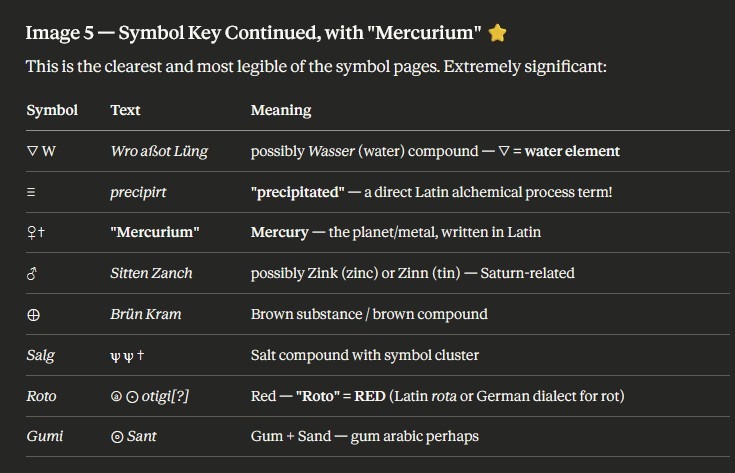
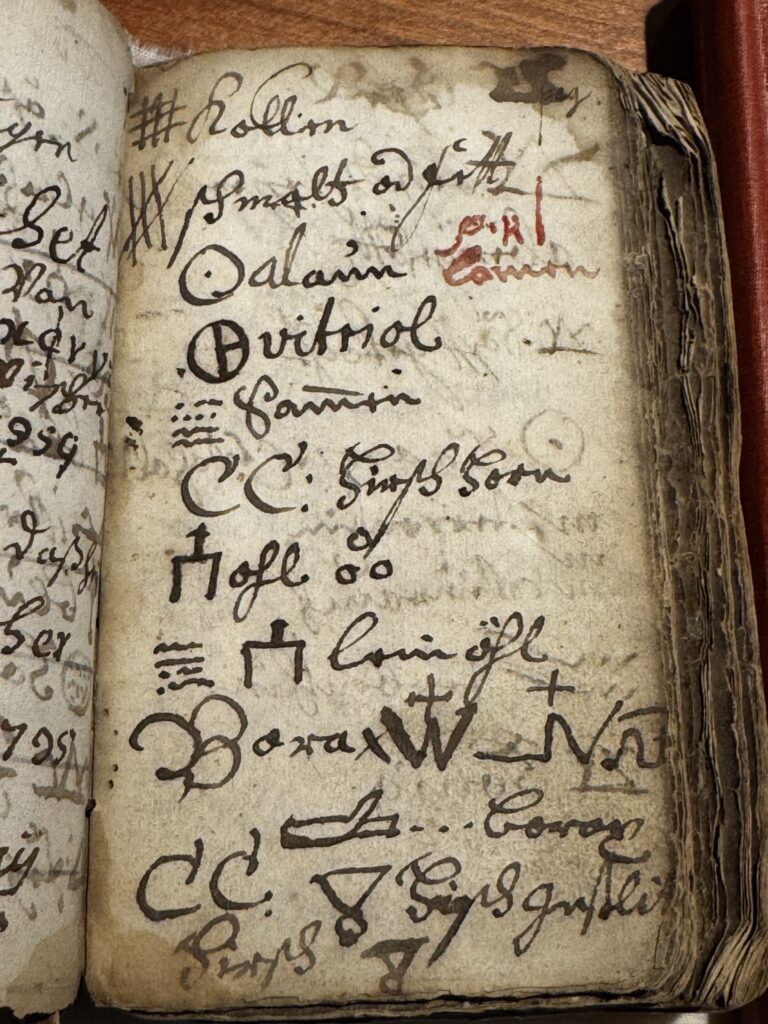
Among the most unusual features of the manuscript is a multi-page symbol glossary near the front. Each entry pairs an alchemical symbol with its corresponding substance or process. The first image below on the far left, we see geometric shorthand featured at the top: a triangle pointing down for water, while metals and minerals such as zinc (Saturn), Mercurium (mercury), and salt are denoted by corresponding planetary symbols, as well as employing the use of Latin in certain cases.
Other substances shown in the images below include vitriol, borax, calamine, smalt, and amber. The entry precipirt — ‘precipitated’ — shows that the key encodes alchemical processes, not just ingredients. This was efficient technical shorthand, the early modern equivalent of chemical notation.
Sample pages from the symbol glossary. Each alchemical sign is paired with the substance or process it represents, from elemental triangles to planetary metals. (RB 005 McGovern Collection on the History of Medicine. Medical Manuscript, ca. 1526-1635)
The Recipes
Barberry recipe for liver detoxification. (RB 005 McGovern Collection on the History of Medicine. Medical Manuscript, ca. 1526-1635)The combination of Sassafras and Sarsaparilla was the signature anti-syphilitic treatment of the late 16th and 17th centuries. (RB 005 McGovern Collection on the History of Medicine. Medical Manuscript, ca. 1526-1635)Recipe for treating “Podagra”, or gout; also famously referred to as the “disease of kings” due to its association with rich foods and wine. (RB 005 McGovern Collection on the History of Medicine. Medical Manuscript, ca. 1526-1635)
The recipe in the top-left image is almost certainly Berberis Pillen — pills made from barberry (Berberis vulgaris), a plant widely used in early modern medicine as a purgative and liver remedy. The color division in the heading may signal the dual nature of the remedy — green for the plant/herbal component, red for its heating or active properties. Next, we see a heading that may be “Salva-tor Pillen” — “Savior Pills” — a common name for a powerful compound remedy. The bottom section of that same page likely referring to Sassafras + Sarsaparilla — two New World plants that arrived in European medicine in the 16th century, used heavily to treat syphilis (morbus gallicus) and skin diseases. Their presence here is a strong dating indicator — they couldn’t appear before the mid-1500s, supporting the manuscript’s 1526+ origin.
In the above top-right image, we find a recipe for the treatment of Podagra. “Podagra” is the Latin word for gout (severe joint pain and inflammation), an illness humans have been well-acquainted with for centuries. The “▽” (water/cold triangle) next to “Podagra” here is meaningful — gout was understood in humoral medicine as a cold, moist condition (excess phlegm settling in the joints), so the water symbol classification is medically coherent within the humoral system.
1635: Plague in Bavaria
The date of Fischer’s acquisition — May 1635 — matters. The plague outbreak of 1634-35 was one of the worst to strike Bavaria in the early modern period, killing tens of thousands. Nuremberg and the surrounding region, where Fischer lived, were among the hardest hit. He may have sought out this book precisely because of what was happening around him.
The manuscript’s plague section catches the eye almost immediately. The word “Pestis” — Latin for plague — is written in large, dramatic deep red ink, almost blood-colored, dominating the page. The color choice here feels anything but arbitrary. The recipe it introduces calls for valerian, elderflower, and ginger, boiled and drunk twice daily for six months.
“Rp Baldrian, Salinen, bolden blatter, Jmber angeott — trinck alle tag je zwer, Abent und Morg. — und es gilt 1/2 halbes Jahr.
(rough translation):
“Take valerian, saline, elderflower leaves, ginger — boiled — drink every day twice, evening and morning — good for half a year.”
(RB 005 McGovern Collection on the History of Medicine. Medical Manuscript, ca. 1526-1635)
Dating the Book
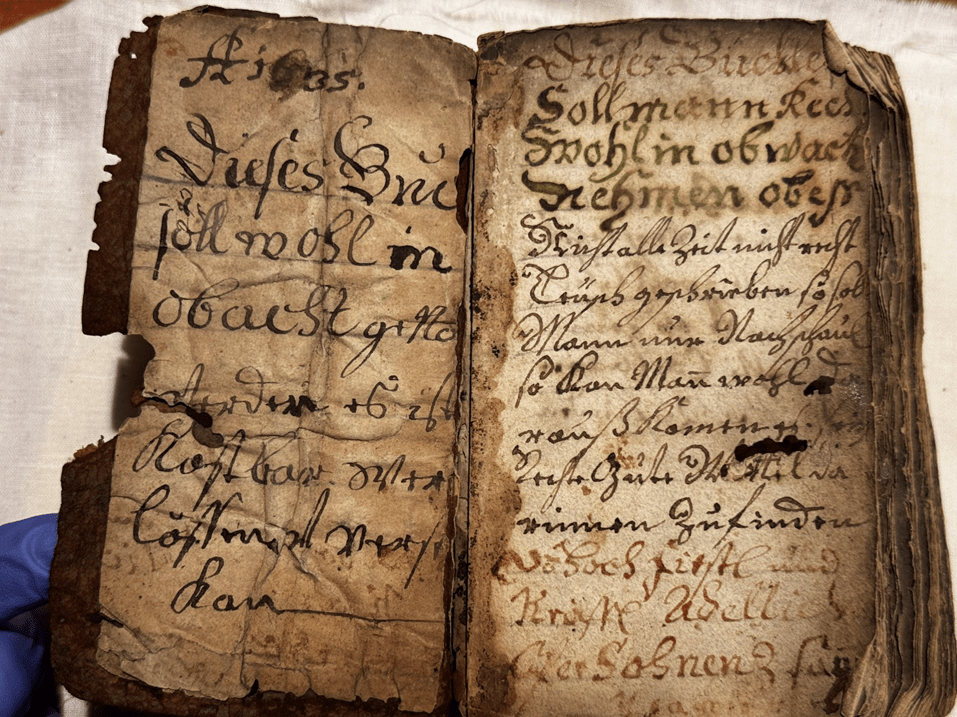
As I mentioned in the introduction, the quickest and best way to get some useful information and possibly some traction in finding out what exactly how old this unique book was and who it belonged to, I elected to utilize Google Gemini for an initial translation and Claude for an independent second opinion. According to both AI engines, it seems that the first two preliminary leaves of the manuscript contain a series of ownership inscriptions.
First two preliminary pages. (RB 005 McGovern Collection on the History of Medicine. Medical Manuscript, ca. 1526-1635)
The right-hand page is the most legible, roughly translating to: “This little book shall be taken good care of, even though it is not written at all times with [proper] ink…” The left page appears to be a slightly different hand — possibly a later owner echoing/copying the same ownership warning. It reads similarly: “Dieses Büchlein soll wohl in obacht gehalten werden…” — “This little book should be well kept/looked after.”
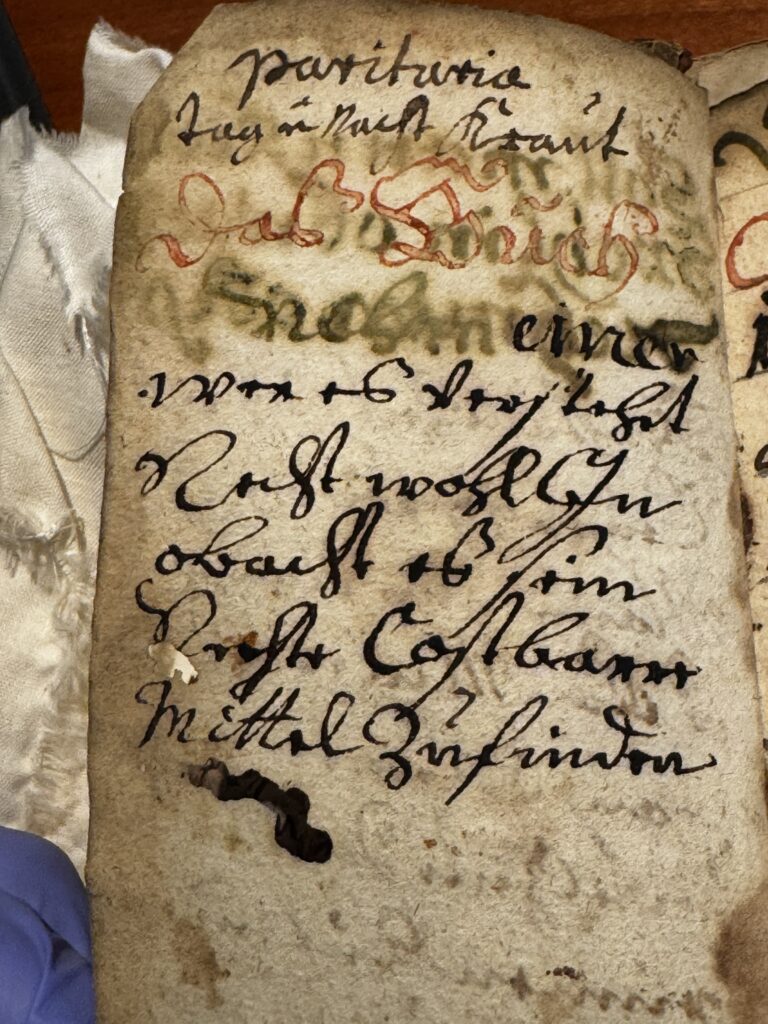
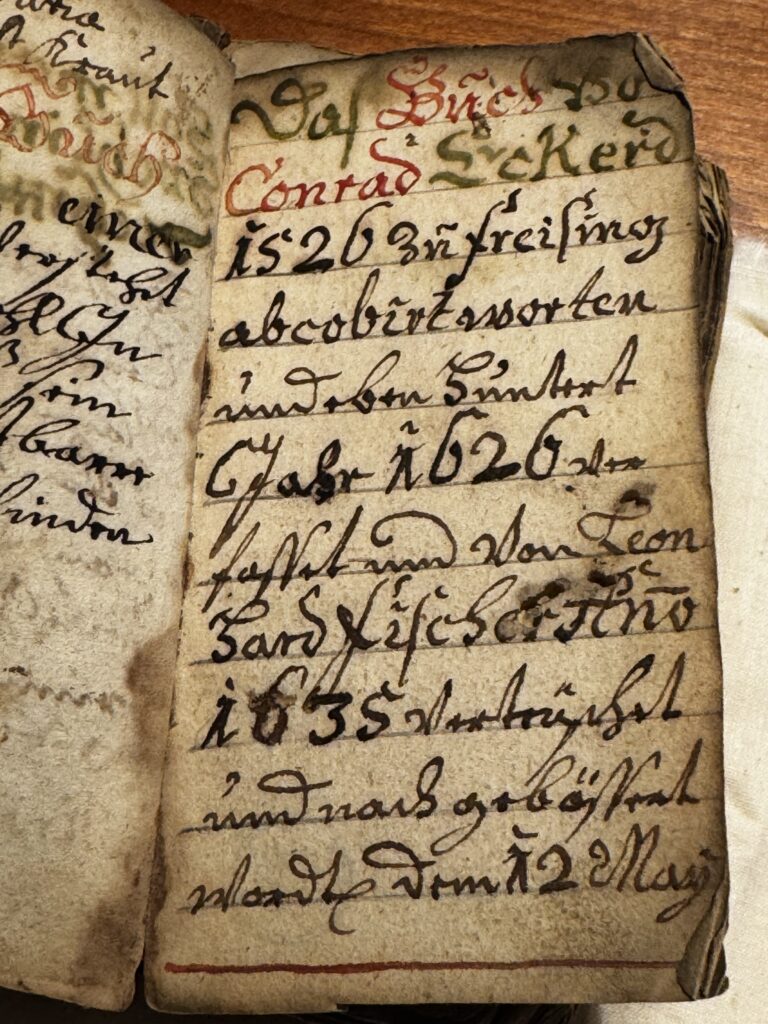
Preliminary page 3 appears to be another page dedicated to a recipe or formula; however, preliminary page 4 proved to be an essential piece of evidence in determining both date and ownership. According to both Gemini and Claude, the script here roughly translates to: “Das Büchlein von Conrad [Seckerd/Deckerd]” — “This little book of/by Conrad [surname]” / “1526 zu Freising abcopiert worden” — “copied/transcribed in 1526 at Freising” — Freising is a town in Bavaria near Munich, historically significant as a bishopric / “und den 5 hundert… Jahr… 1626” — possibly referencing the book being 100 years old by 1626, or a second copying event / “fasset und von Leonhard Fischer Anno 1635 vertrüget” — “compiled/held and by Leonhard Fischer in the year 1635 [transferred/conveyed]” / “und nach gebüstrat worden dem 12 May” — “and thereafter registered/recorded on the 12th of May”.
All of a sudden, we have three dates: 1526 (original copying at Freising), 1626 (possibly a centennial reference or intermediate event), and 1635 (transfer of ownership to or by Leonhard Fischer on May 12).
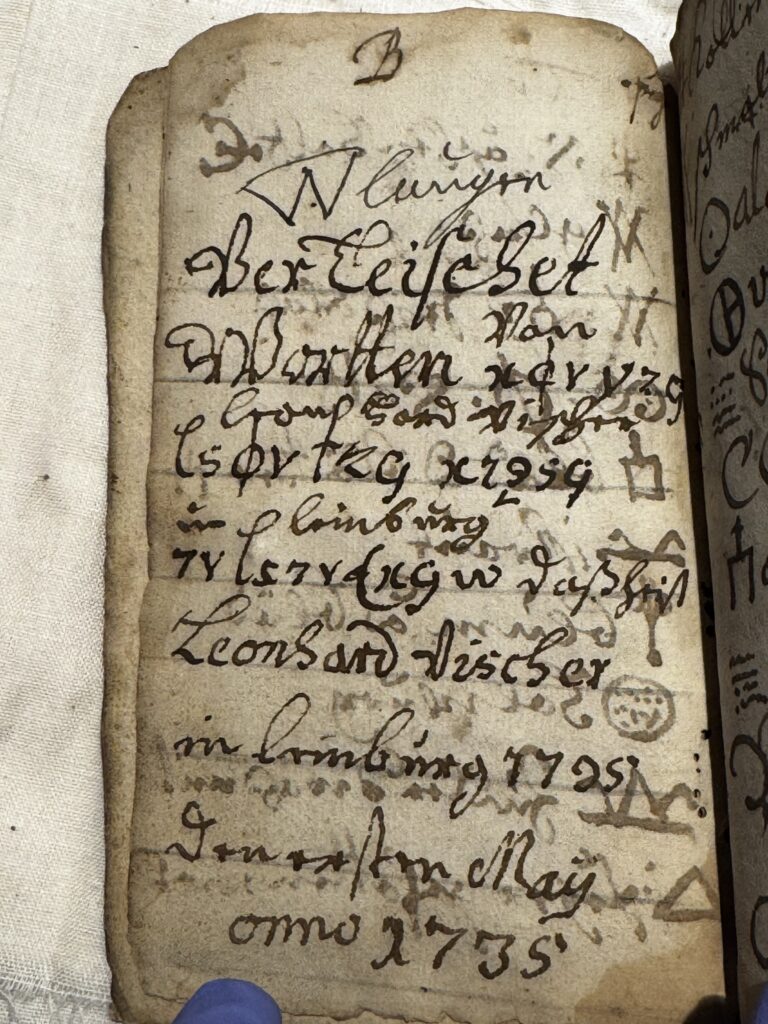
Preliminary page 5 was even more critical in assigning a date and identifying potential owners of the manuscript. Ludwig Dörgel, Student of Surgery in Nuremberg, is very likely one of the previous owners of this manuscript.
Preliminary page 6 shows bleed-through of “ORA ET LABORA” in mirror writing from the previous leaf, confirming these are consecutive pages. Below, in the mirror text you can faintly make out “Anno 1635 Von Hier Leonhard Cristoph Fischer“. This is noteworthy, as it confirms what the previous page suggested: Leonhard Christoph Fischer received or registered this book in 1635. In addition, the geographic thread connecting all known owners is also undeniable: Freising, Leinburg, and Nuremberg are all within roughly 60 miles of one another, tracing a coherent Bavarian arc across more than a century.
In light of this helpful (though not authoritative) information, it’s fair to assume the following timeline and transfers of ownership for this manuscript are plausible and merit at least some consideration in terms of bibliographic information:
1526 Copied (abcopiert worden) in Freising, Bavaria, by or for a person named Conrad. Several recipes in the book are attributed to Conrad by name, suggesting he was the primary compiler.
1626 A second date appears in the preliminaries — likely a centennial notation or record of an intermediate copying event.
1635 The book is formally transferred to Leonhard Christoph Fischer of Leinburg, Bavaria, near Nuremberg, on the 12th of May. That same year, Ludwig Dorgel, a Student of Surgery in Nuremberg, inscribes his name on the title page and adds the motto ORA ET LABORA — ‘Pray and Work.’
The Role of AI
The script — an early form of German cursive known as early Kurrent — is genuinely difficult to read. Google Gemini provided initial translations of the preliminary leaves. Claude then reviewed the same pages independently. Where both tools agreed, confidence is higher; where they diverged, we flag uncertainty. Both agreed on the key names and dates.
AI-assisted translation is not a substitute for expert paleographic analysis. The readings here are working hypotheses, not established facts, and should be treated as provisional until reviewed by a specialist in early modern German manuscripts. What AI provided is a meaningful head start — a set of interpretive possibilities that human expertise can now refine or correct.
Below: What the AI models were working with: a page of early Kurrent script alongside our working transcription. Where both AI tools agreed, confidence is higher; where they diverged, we flag with uncertainty.
Screenshot of translation of a sample page (opposite) of alchemical symbols. ClaudeAI; February 19, 2026.
Final Thoughts
It is tempting to treat rare manuscripts as trophies of age. But the deeper value of this manuscript is not simply that it is old. It is that it is human. It preserves: early modern strategies for managing fear, pain, and illness; the blending of household knowledge with learned medical tradition; the symbolic language of early chemistry and materia medica; and the long life of one small book passed from hand to hand.
This manuscript reminds us that medical history is not only the history of institutions and printed treatises. It is also the history of households, bodies, recipes, repeated attempts—and the stubborn hope that suffering can be eased.
Works Cited
Note: All translations from the manuscript are provisional and subject to specialist review. Works cited here provide broader scholarly context for the manuscript’s content, script, and historical setting.
Early Modern Manuscript Recipe Tradition
Kernan, Sarah Peters, and Helga Müllneritsch. “Introduction: Manuscript Recipe Books in Early Modern Europe.” Manuscript Recipe Books in Early Modern Europe, edited by Kernan and Müllneritsch, Johns Hopkins University Press, 2023, pp. 1–30.
Leong, Elaine. “Making Medicines in the Early Modern Household.” Bulletin of the History of Medicine, vol. 82, no. 1, 2008, pp. 145–68.
Rankin, Alisha. “Recipes in Early Modern Europe.” Encyclopedia of the History of Science, Carnegie Mellon University Press, 2023.
Rankin, Alisha. “Exotic Materials and Treasured Knowledge: The Valuable Legacy of Noblewomen’s Remedies in Early Modern Germany.” Renaissance Studies, vol. 28, no. 4, 2014, pp. 533–55.
Kurrent and Early Modern German Script
“German Kurrent.” Ad Fontes: Introduction to Latin Palaeography, University of Zurich, www.adfontes.uzh.ch.
“History of the Old German Script.” Walden Font Co., www.waldenfont.com/OntheHistoryofOldGermanScript.asp.
Peucker, Paul, et al. “German Script Course (Early Modern German Paleography).” Moravian Archives, Bethlehem, PA, 2017.
Alchemical Symbol Systems and Early Modern Alchemy
“Alchemical Symbol.” Wikipedia: The Free Encyclopedia, Wikimedia Foundation, en.wikipedia.org/wiki/Alchemical_symbol.
“Paracelsus.” Wikipedia: The Free Encyclopedia, Wikimedia Foundation, en.wikipedia.org/wiki/Paracelsus.
Timmermann, Anke. “Doctor’s Order: An Early Modern Doctor’s Alchemical Notebooks.” Early Science and Medicine, vol. 13, no. 1, 2008, pp. 25–52.
The Bavarian Plague of 1634–35 and the Thirty Years’ War
Alfani, Guido, and Tommy E. Murphy. “Plague and Lethal Epidemics in the Pre-Industrial World.” Journal of Economic History, vol. 77, no. 1, 2017, pp. 314–43.
Picard, Julien, et al. “Conflicts and the Spread of Plagues in Pre-Industrial Europe.” Humanities and Social Sciences Communications, vol. 7, 2020.
Wilson, Peter H. Europe’s Tragedy: A History of the Thirty Years War. Belknap Press of Harvard University Press, 2009.
Barber-Surgeons and Early Modern Surgery
“Barber Surgeon.” Wikipedia: The Free Encyclopedia, Wikimedia Foundation, en.wikipedia.org/wiki/Barber_surgeon.
Rutkow, Ira. “Respectful Image: Revenge of the Barber Surgeon.” Annals of Surgery, vol. 241, no. 6, 2005, pp. 872–78.
Materia Medica: Sarsaparilla, Sassafras, and New World Drugs
Huguet-Termes, Teresa. “New World Materia Medica in Spanish Renaissance Medicine.” Medical History, vol. 45, no. 3, 2001, pp. 359–76.
Schiebinger, Londa, and Claudia Swan, editors. Colonial Botany: Science, Commerce, and Politics in the Early Modern World. University of Pennsylvania Press, 2005.
Vermeer, Hieke. “Plant of the Month: Sarsaparilla.” JSTOR Daily, 3 Dec. 2025, daily.jstor.org/plant-of-the-month-sarsaparilla/.
Winterbottom, Anna E. “Of the China Root: A Case Study of the Early Modern Circulation of Materia Medica.” Social History of Medicine, vol. 28, no. 1, 2015, pp. 22–44.
Nuremberg and Bavarian Medical Centers
Murphy, Hannah. A New Order of Medicine: The Rise of Physicians in Reformation Nuremberg. University of Pittsburgh Press, 2019.
Wallis, Patrick. “Exotic Drugs and English Medicine: England’s Drug Trade, 1550–1800.” Social History of Medicine, vol. 25, no. 1, 2012, pp. 20–46.
Translations are provisional and subject to revision by specialist review. AI-assisted analysis conducted using Google Gemini and Anthropic Claude.





 Recipe for treating “Podagra”, or gout; also famously referred to as the “disease of kings” due to its association with rich foods and wine. (RB 005 McGovern Collection on the History of Medicine. Medical Manuscript, ca. 1526-1635)