By Tara Sims, Archivist and Special Collections Librarian
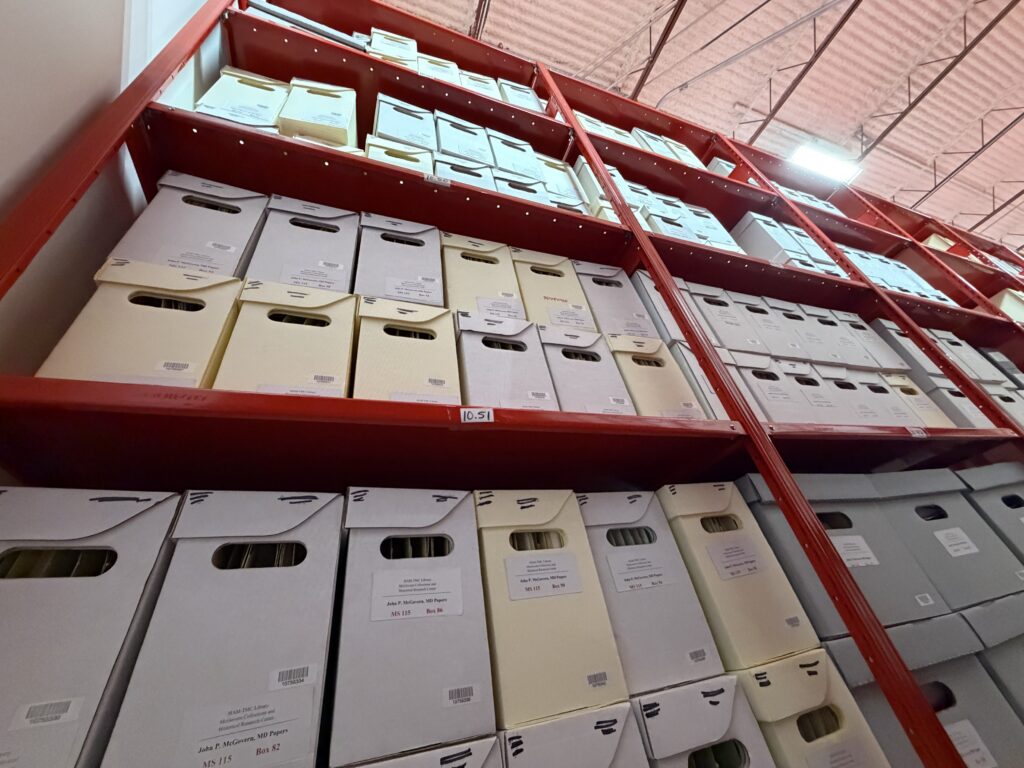
After nearly three years of sustained archival work, the John P. McGovern, M.D. Papers (MS 115) are now fully processed, described, and searchable through the John P. McGovern Historical Collections and Research Center’s online catalog at the Houston Academy of Medicine–Texas Medical Center Library. Researchers anywhere in the world can now explore one of the Center’s most significant manuscript holdings at the folder and item level, with rich metadata designed to surface the collection’s remarkable breadth across multiple disciplines and decades.
A Collection Worth the Work
John Phillip McGovern (1921–2007) was a physician, allergist, pediatrician, medical humanist, rare book collector, and philanthropist whose life touched nearly every corner of twentieth-century American medicine. His papers reflect that extraordinary range: 277 archival boxes spanning more than a century of accumulated material, arranged across eighteen series and encompassing correspondence, clinical research files, published and unpublished manuscripts, speeches, photographs, academic regalia, honorary degrees, awards, audiovisual recordings, and the philanthropic records of the John P. McGovern Foundation. For researchers interested in the history of allergy and immunology, the Oslerian movement in American medicine, medical humanism, substance abuse prevention, or the History of Medicine rare book collection at the Texas Medical Center Library, this collection is an essential primary source.
From Rough Inventory to Full Description
The path to discoverability was not a short one. The project began with an inherited rough box-level inventory that reflected the collection’s long and layered accretion history — materials donated across decades, in multiple accessions, by McGovern himself and later by his estate. What that inventory could not do was tell a researcher what was actually inside those 277 boxes in any meaningful way.
The work of the past three years has transformed that situation entirely. Every box was rehoused in new archival materials. The inventory was rebuilt from the ground up, progressing from box-level description to folder-level description throughout, and to item-level description wherever the significance of individual items warranted it (which, in a collection of this depth, was often). Series 2 alone, documenting McGovern’s relationship with Duke University School of Medicine Dean Wilburt Cornell Davison, M.D., required item-level description of nearly 200 individual folders of correspondence, reprints, photographs, oral history transcripts, and realia spanning Davison’s entire career from 1913 through his death in 1972.
A Scope and Contents Note Built for Discovery
Alongside the folder- and item-level descriptions, the online record for MS 115 includes a comprehensive collection-level scope and contents note that gives researchers an orientation to the collection as a whole, followed by individual series-level scope notes that describe the intellectual content, arrangement, and highlights of each of the eighteen series. Crucially, the description does not stop there. Every folder in the collection carries its own summary note in the online catalog and a brief but specific description of exactly what that folder contains. Rather than encountering a vague label like “Professional Correspondence, A–B,” a researcher browsing the online catalog will find a note explaining precisely which organizations or individuals are represented, what types of materials are present, and whether any items of particular significance — a manuscript draft, a signed photograph, a restricted clinical record — are included. Taken together, the collection-level note, the series notes, and the individual folder descriptions constitute a box-by-box, folder-by-folder account of one of the largest and most complex manuscript collections in the Center’s holdings. Researchers can now peruse the entire intellectual map of MS 115 from their own desk before ever contacting the repository.
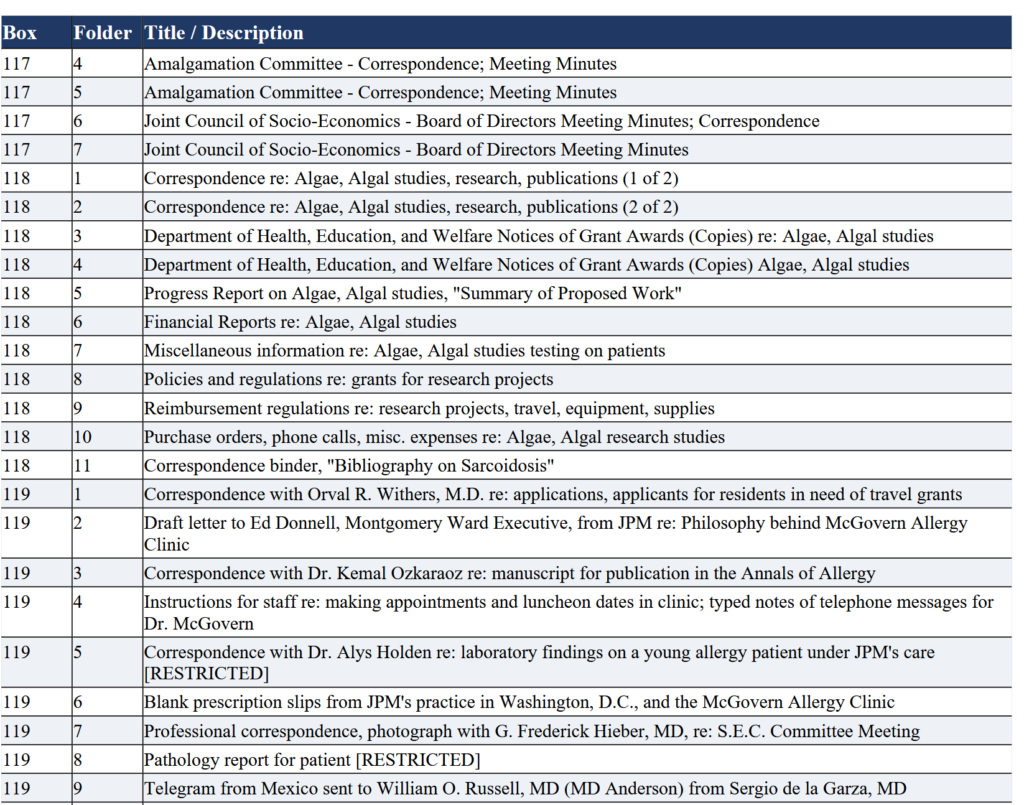
Series 3 (Professional Papers); generated June 29, 2026.
Metadata That Does the Work for Researchers
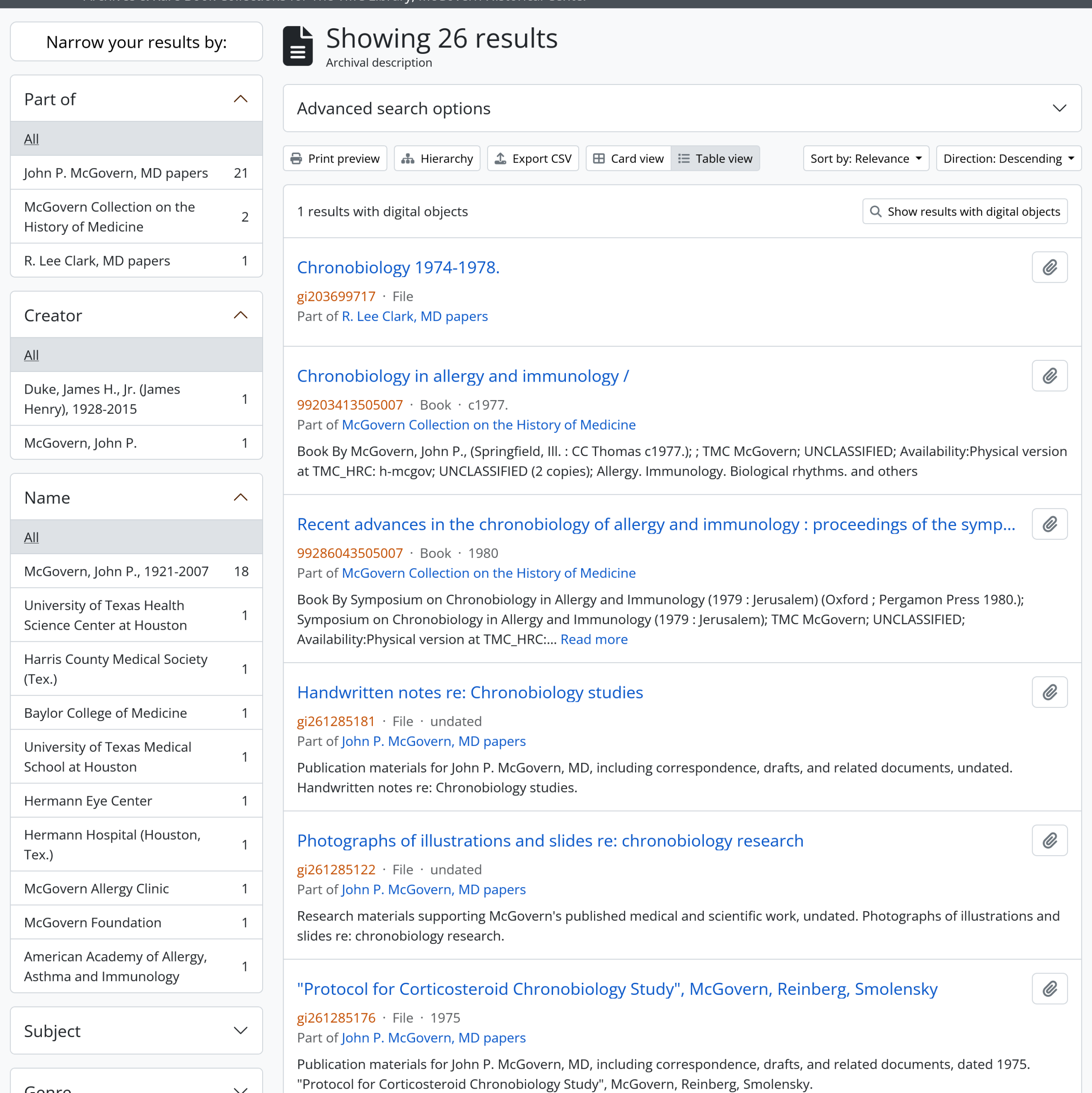
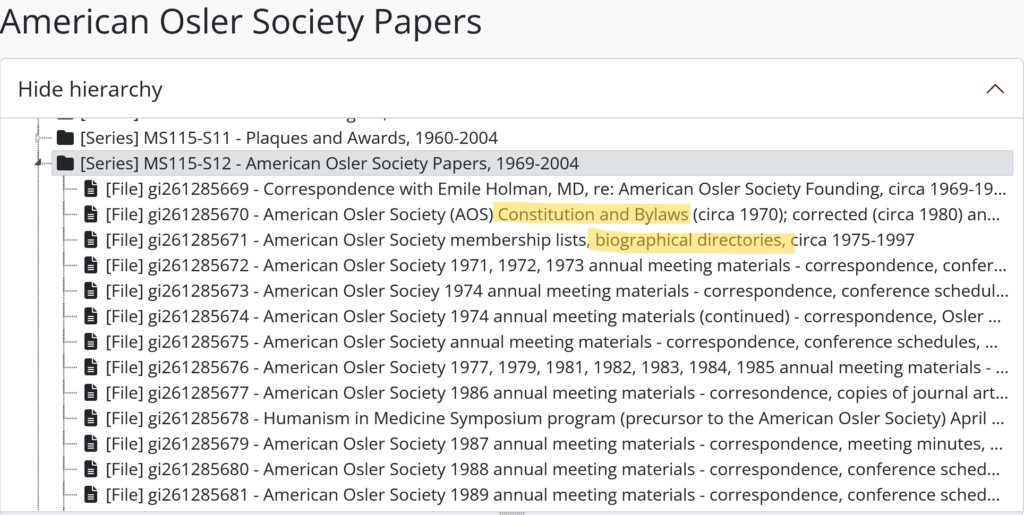
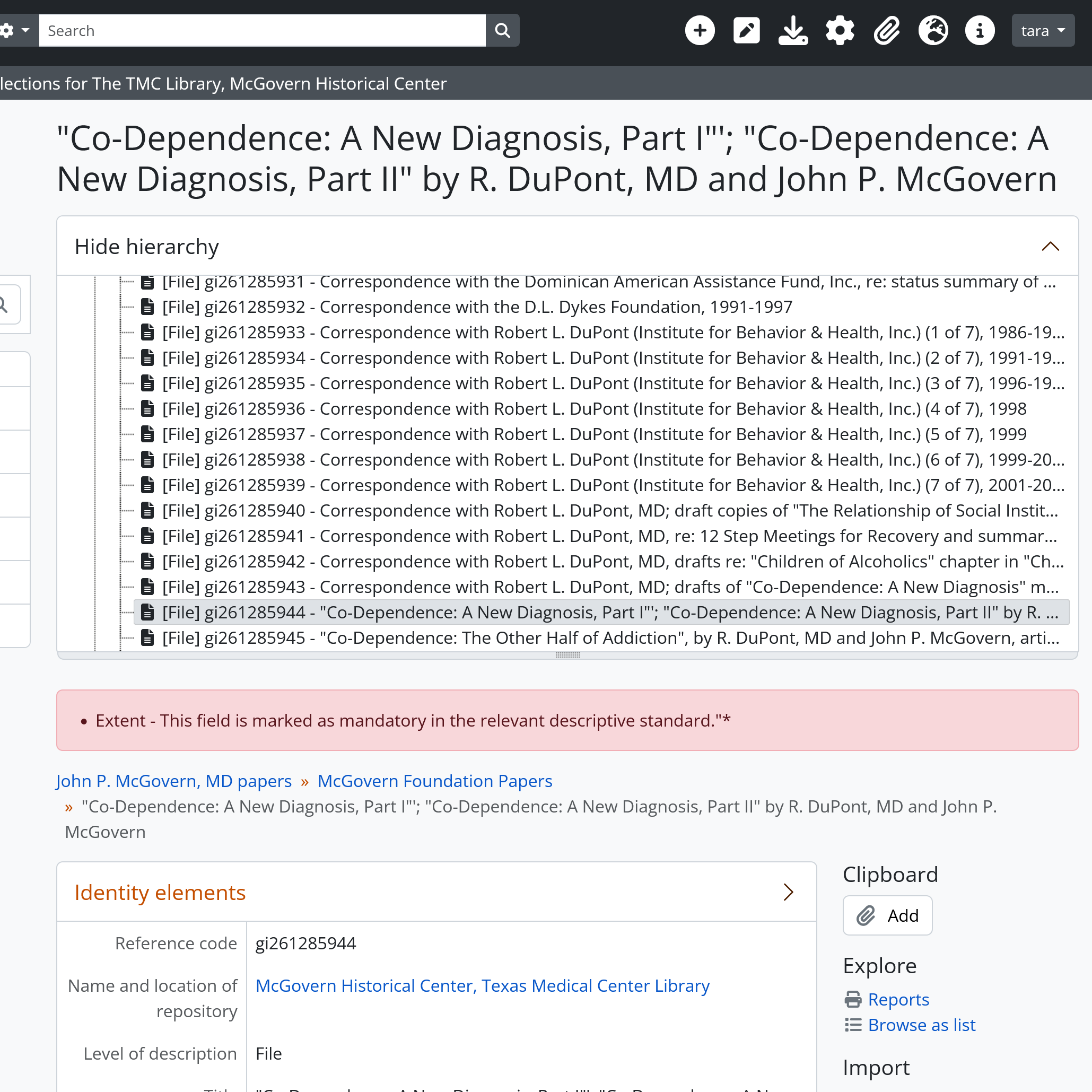
What makes the online record for MS 115 genuinely useful, rather than merely present, is the depth and specificity of the metadata now attached to nearly 3,000 individual descriptions within the collection. Subject access points, name access points, place access points, and genre terms have been assigned at the file and item level throughout, drawing on Library of Congress Subject Headings, RBMS Controlled Vocabularies, and the repository’s own AtoM genre taxonomy. A researcher interested in McGovern’s work in chronobiology, for example, can conduct a simple keyword search for “choronobiology” on AtoM and get dozens of results in the collection for research materials, protocols, circadian rhythm graphs, photographs, 35mm slides, correspondence with colleagues, and publications relating to this topic — with accurate box and folder numbers where each item can be found. An interested historian or member of the American Osler Society can navigate directly to the organization’s constitution and bylaws or old biographical directories. A scholar studying co-dependence and addiction medicine in the late twentieth century can surface seven folders of McGovern’s correspondence and co-authored manuscripts with Robert L. DuPont, M.D. without having to page through boxes of unrelated professional correspondence to find them.
Name authority work was carried out throughout the project to ensure that individuals represented across the collection — from Sir William Osler and Wilburt Cornell Davison to Helen Hayes MacArthur and Kathy McGovern — are consistently identified and linked using established authority forms, so that a search on any of these names retrieves everything in the collection where they appear.
What This Means for Researchers
The practical result is a collection that was previously accessible only to researchers willing to visit in person and work through a minimal inventory now opens itself up to remote discovery in ways that reflect the true richness of what Dr. McGovern preserved. The online record supports targeted searching by person, subject, place, date range, genre, and keyword, and between the individual folder notes and the layered scope and contents descriptions, the descriptions are detailed enough that a researcher can often determine whether a specific folder is worth requesting before they ever set foot in the reading room.
Again, the John P. McGovern, M.D. Papers are available for research use in the reading room of the John P. McGovern Historical Collections and Research Center, and the online finding aid is accessible through the Center’s AtoM catalog at archives.library.tmc.edu. Researchers with questions about the collection or wishing to schedule a visit are encouraged to contact staff at the MHC directly or make an appointment online.