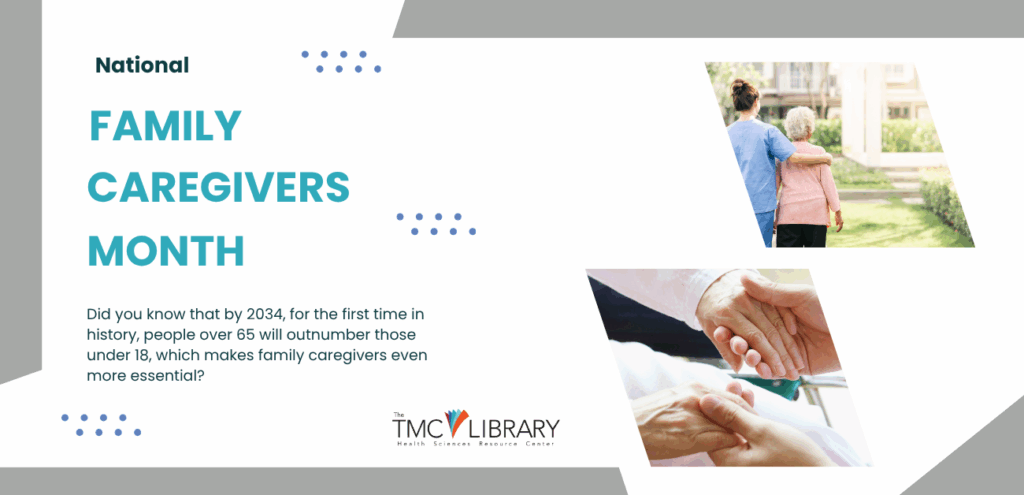
Did you know that by 2034, for the first time in history, people over 65 will outnumber those under 18, which makes family caregivers even more essential? National Family Caregivers Month is celebrated each November to recognize and honor family caregivers across the country. Family caregivers are defined as family members or someone who is identified as “family” who provide assistance and support to an individual with a chronic health condition – including mental health and substance use conditions, disability, or functional limitation. Providing care to a loved one can affect the caregiver in many complex ways: financial stressors, emotional exhaustion, physical fatigue, social isolation, relationship struggles and so much more.
Some interesting facts about Family Caregivers:
- It is currently estimated that 53 million American family caregivers are providing care to a loved one.
- There are also nearly 12 million unpaid dementia caregivers in the United States, 59% of dementia caregivers say that they experience high levels of emotional stress
- The economic value of these unpaid caregivers equals approximately $600 billion per year
Resources at The TMC Library
Electronic Books and Book Chapters
- Favreault, M. M. (2023). Future Change in Caregiving Networks: How Family Caregivers and Direct Care Workers Support Older Adults Now and in the Future. Assistant Secretary for Planning and Evaluation, Office of Behavioral Health, Disability, and Aging Policy.
- Jain, F. A., & Madarasmi, S. (2025). Mindfulness and Resilience. In Massachusetts General Hospital Comprehensive Clinical Psychiatry (Third Edition, pp. 1005–1013). Elsevier Inc. https://doi.org/10.1016/B978-0-443-11844-9.00091-6.
- Rebaudo, M., Calahorrano, L., & Hausmann, K. (2025). Willingness to Care – Financial Incentives and Caregiving Decisions Health Economics, 34(3), 442-455. https://doi.org/10.1002/hec.4918
- Saunders, M. M. (2024) 10 Nursing Interventions for Family Caregivers: Guide to Best Practices in Adult-Gerontology Patient Care. (M. M. Saunders, Ed.; 1st ed.). Springer International Publishing AG. https://doi.org/10.1007/978-3-031-53108-8
- Vallejo-Andrada, A., Jorge-Sánchez, J., Sarasola-Sánchez-Serrano, J. L., & Burgos-Serrano, E. (2025). Informal Caregiver Overload. A Comparison Between Beneficiaries and Non-beneficiaries and Non-beneficiaries of Home Help Services in Seville.. In C. Flaut, P. Rackova, D. Flaut, & S. Hoskova-Mayerova (Eds.), Changes and Innovations in Social Systems (Vol. 505, pp. 295–304). Springer. hhttps://doi.org/10.1007/978-3-031-43506-5_17
Resources available at the Digital Commons@TMC
There are many wonderful articles focusing on various topics, from works highlighting challenges family caregivers go through, shared care networks assisting older adults and more. To view some of the research, visit a selection published in the last 3 years. Some of the highlights include:
- Chary, Anita (2025). https://digitalcommons.library.tmc.edu/baylor_docs/3899/. Baylor College of Medicine: Faculty and Staff Publications. PMID: 39508982
- Sujin, Ann-Yi (2023). Supportive Care for Dual Caregivers who Care for Their Partner With Cancer and Their Young Children. The University of Texas MD Anderson Cancer Center UTHealth Houston Graduate School of Biomedical Sciences: Faculty and Staff Publications. PMID: 37482225
- Cunningham, Phillippe B (2024). Study Protocol For Clinical Trial of the Fit Families Multicomponent Obesity intervention For African American Adolescents and their Caregivers: Next Step From the Orbit Initiative. UTHealth School of Public Health. PMID: 38355187
Free Online Resources
- Caregivers Action Network
- Alzheimer’s Association: Honor a Caregiver
- National Family Caregivers Month: UNSEEN–Caregiver Documentary Film
Please join us as we celebrate this festive month, which is a beautiful opportunity to explore and appreciate the rich heritage that strengthens our institution and the Texas Medical Center.